> For the complete documentation index, see [llms.txt](https://docs.akamas.io/akamas-docs/llms.txt). Markdown versions of documentation pages are available by appending `.md` to page URLs; this page is available as [Markdown](https://docs.akamas.io/akamas-docs/3.5.0/integrating/integrating-value-stream-delivery.md).
# Integrating with pipelines
Akamas can integrate virtually with any pipeline tools to support the ability to optimize systems as part of a Continous Integration / Continous Delivery (CI/CD) process.
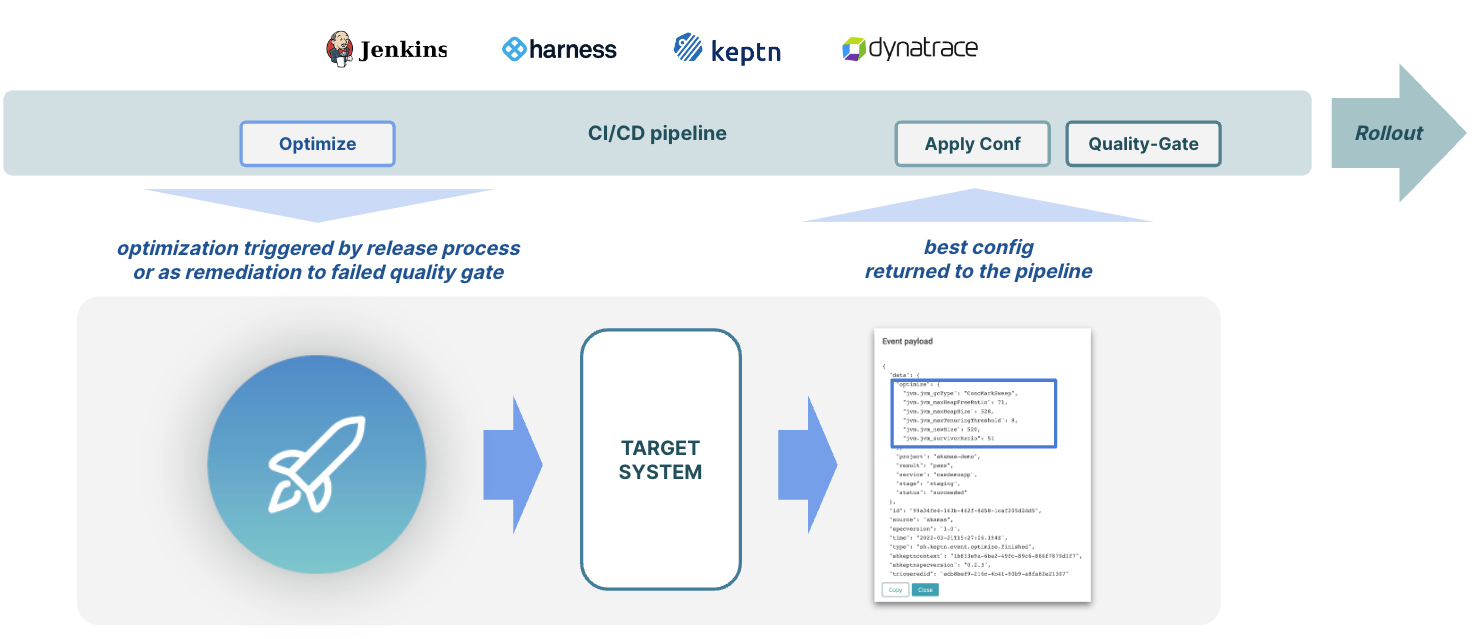
When integrated into a CI/CD process, the Akamas optimization becomes an additional step that can ensure a new version that is being released will not cause incidents due to bad configurations pushed to production that nobody has time to look at and that can require adjustments to make the new release perform best.
By integrating Akamas in the CI/CD pipeline, it is possible to also ensure the new release is not only passing functional and security tests but also that:
* performance regressions with respect to previous builds are avoided, such as regressions with respect to some key performance indicators (or SLOs) such as service response time or resource consumption;
Reactive optimization: in-the-pipe remediation (optimization task is triggered by quality gate)
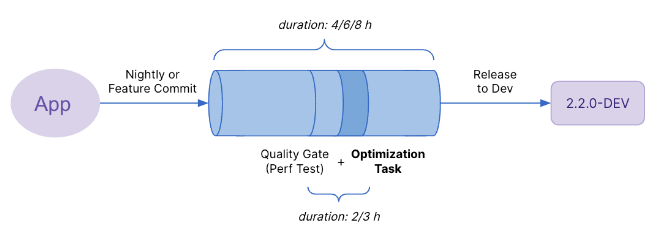
* configuration settings are properly tailored for the new release, thus avoiding configuration bottlenecks (e.g. wrong JVM settings or smaller Kubernetes pod resources for the new release) and decreasing the risk of performance or availability incidents.
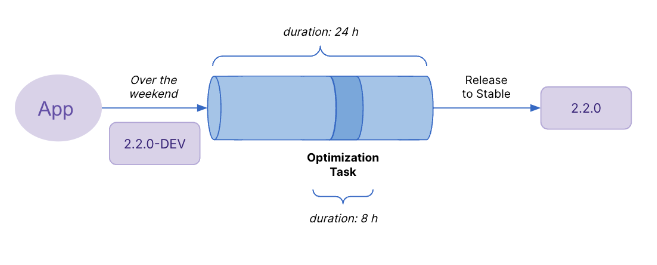
Proactive optimization in-the-pipe
---
# Agent Instructions
This documentation is published with GitBook. GitBook is the documentation platform designed so that both humans and AI agents can read, navigate, and reason over technical content effectively. Learn more at gitbook.com.
## Querying This Documentation
If you need additional information that is not directly available in this page, you can query the documentation by asking a question.
Perform an HTTP GET request on the following URL with the `ask` and `goal` query parameters:
```
GET https://docs.akamas.io/akamas-docs/3.5.0/integrating/integrating-value-stream-delivery.md?ask=&goal=
```
`ask` is the immediate question: it should be specific, self-contained, and written in natural language.
`goal` is what the user is ultimately trying to achieve, the reason they need the answer. Sharing it helps GitBook give you a better, more relevant answer. A goal is most helpful when it describes the outcome the user wants rather than restating the question. For example, with `ask=how do I create an API token`, a goal like `automate deployments from our CI pipeline` lets GitBook tailor the answer to that use case.
The response will contain a direct answer to the question and relevant excerpts and sources from the documentation.
Use this mechanism when the answer is not explicitly present in the current page, you need clarification or additional context, or you want to retrieve related documentation sections.